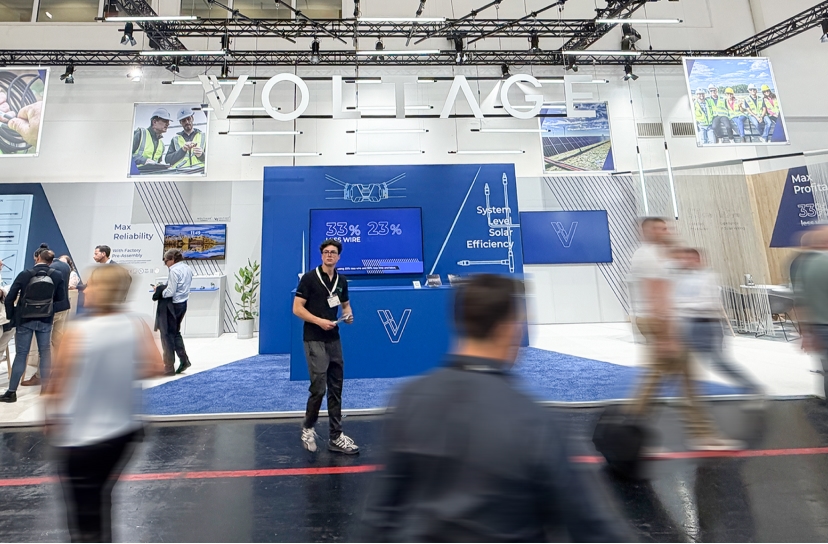
From 1,500V to 2kV: Why EBOS Design Will Determine the Next Phase of Utility-Scale Solar? Voltage Energy Partners with UL Solutions to Advance Full-System 2kV EBOS Standards.


As utility-scale solar projects accelerate the transition to 2kV system architectures, the industry is increasingly focused on whether higher voltage can deliver real-world cost reductions and efficiency improvements. A key determinant is the electrical balance of system (EBOS): the DC-side infrastructure that safely, reliably, and efficiently collects PV power and delivers it to inverters and combiner equipment.
EBOS as the Deciding Factor in Practical 2kV Performance
In utility-scale 2kV PV systems, voltage establishes the technical ceiling for efficiency gains, but EBOS architecture determines whether that potential is realized in the field. While higher voltage enables lower current and longer strings, system-level performance ultimately depends on how effectively the DC infrastructure is designed, integrated, and deployed at scale.
A common market assumption is that 2kV systems can be achieved by scaling existing 1,500V designs. In practice, the shift to 2kV introduces higher DC power density, longer string runs, and more complex electrical layouts, fundamentally changing system requirements. When EBOS is treated as an extension of 1,500V architectures, added safety margins often lead to longer cable runs, larger conductor sizes, and increased redundancy, reducing material efficiency and eroding much of the higher-voltage advantage. These challenges underscore a central industry reality: capturing the full value of 2kV operation depends not only on the voltage rating but also on whether the EBOS architecture is designed specifically for 2kV operating conditions.
Voltage Energy's Purpose-Built 2kV EBOS Architecture, Validated by UL Certification
On January 7, 2026, UL Solutions held a certification ceremony recognizing Voltage Energy Group (Voltage Energy)’s full-system 2kV EBOS for photovoltaic applications. The certification covers Voltage Energy's LYNX, IBEX PLUS, IBEXand ALEX product families and confirms compliance with UL 9703 requirements. Fred Wang, Voltage Energy’s VP of Production, and Evan Xiao, UL’s Asia Regional General Manager, attended the event to mark the milestone in the organizations’ collaboration.
Voltage Energy's 2kV EBOS solutions are purpose-built for 2kV operation. Designed for constructability and large-scale deployment, the architecture optimizes conductor sizing, electrical layout, and modular block design:
• Optimized conductor sizing: Conductor specs are matched to 2kV electrical and thermal requirements, balancing compliance, thermal performance, and material efficiency.
• Efficient electrical layouts: Streamlined routing reduces cable length, crossings, and congestion, improving installation efficiency and commissioning predictability.
• Scalable block architecture: Modular blocks support repeatable replication and expansion, with clear circuits, simpler construction, and long-term operability.
Together, these design choices translate higher system voltage into practical, system-level efficiency rather than theoretical gains on paper.
Quantifying System-Level Benefits at Scale
In like-for-like block comparisons, utility-scale PV systems deployed with the LYNX 2kV architecture typically demonstrate reductions in overall conductor usage, system weight, and voltage drop compared with conventional 1,500V designs. In representative block layouts, the shift to a higher-voltage architecture can reduce total DC cable length by approximately 26%, primarily by enabling longer string configurations and reducing the number of parallel circuits. By aligning EBOS architecture with higher-voltage operation from the outset, these systems convert voltage headroom into measurable improvements in transmission efficiency and material utilization.
At the system level, these gains translate directly into BOS benefits, including lower material costs, reduced transportation and lifting requirements, faster field installation, and clearer long-term operations and maintenance pathways. In like-for-like evaluations, the combined effect has been modelled to support an approximately 42% reduction in EBOS cost and an approximately 32% improvement in installation efficiency, driven by simplified electrical layouts and an approximately 24% reduction in module-related installation tasks. For EPCs and project developers, system-level optimization also enables greater design flexibility, simplified electrical planning, and improve schedule predictability across the project lifecycle.
With purpose-built 2kV EBOS solutions such as LYNXand IBEX PLUS, Voltage Energy enables utility-scale solar projects to move beyond theoretical voltage advantages and realize quantifiable gains in cost, schedule, and system manageability. The company’s 2kV EBOS solution provides a scalable, repeatable foundation for next-generation utility-scale PV projects, fully unlocking the value of higher-voltage system architectures.
The UL certification goes beyond validating individual components or voltage ratings. It confirms Voltage Energy’s 2kV EBOS as an integrated system architecture, engineered, tested, and verified to operate cohesively under real-world 2kV conditions. By validating system-level interactions across conductors, connectors, routing, protection, and modular block design, the certification elevates 2kV EBOS from a project-specific configuration to a repeatable, bankable solution deployable with confidence at utility scale.
Enabling the Next Phase of 2kV Utility-Scale Solar
As the utility-scale solar industry moves from early 2kV adoption toward broader deployment, the prerequisites for success are becoming increasingly clear. Higher voltage alone is insufficient; scalable 2kV systems require purpose-built EBOS architecture, validated at the system level and supported by recognized certification frameworks.
With UL-certified 2kV EBOS platforms such as LYNX, IBEX PLUS, IBEX and ALEX, Voltage Energy is helping establish a repeatable foundation for the next phase of high-voltage PV development, supporting faster project delivery, improved bankability, and the continued standardization of 2kV utility-scale solar.
About Voltage Energy Group
Founded in 2015, Voltage Energy Group (“Voltage Energy”) is a leading global provider of electrical balance of systems (EBOS) solutions for utility-scale solar projects, with headquarters in Chapel Hill, North Carolina, and a European office in Frankfurt, Germany.
Voltage Energy has demonstrated consistent year-over-year growth and delivers innovative, value-engineered technologies that enhance installation efficiency, safety, and long-term system performance. Deeply committed to service excellence, the company supports smarter project execution through advanced visualization tools such as 3D renders, 360-degree walk-throughs, and virtual reality previews. Its flagship products, VOLTAGE LYNX, VOLTAGE ALEX, and VOLTAGE IBEX, can be tailored into flexible, customized solutions with the agility to meet each client’s unique requirements, underscoring the company’s enduring focus on customer-centric service and long-term success.